Most people arrive in Santorini with beaches as an afterthought. They come for the sunsets, the caldera views, the whitewashed architecture that has become one of the most photographed landscapes on earth. The beaches, in the popular imagination, are a secondary consideration — something to squeeze in between the wine tastings and the boat tours.
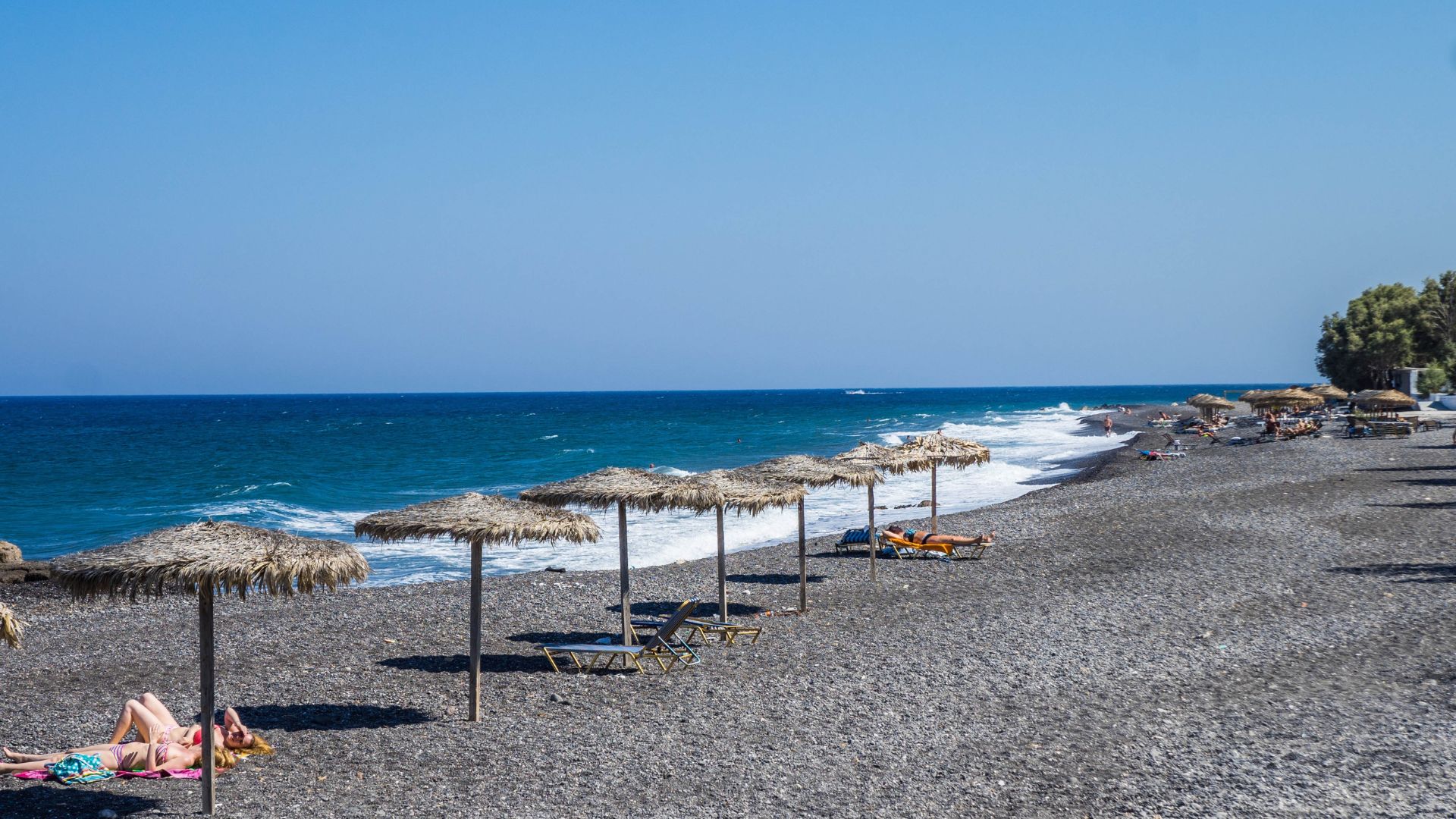
That is a mistake. Santorini’s beaches are unlike anything else in Greece, and unlike anything else in the world. They are not the turquoise-and-white-sand beaches of a travel brochure. They are volcanic. Black, red, and occasionally deep grey, formed from lava and ash and centuries of the sea working against rock that was born in catastrophe. Swimming in them feels like entering a painting that someone got slightly wrong — the colors are too saturated, the contrasts too sharp, the whole scene too dramatic to be entirely real.
This guide covers all of them — the famous, the underrated, the ones that require a boat and the ones that are five minutes from the road. It is written for people who want to actually understand the island, not just navigate its most photographed corners. And it is written with the honest acknowledgment that where you stay determines which beaches become yours.
If you happen to be staying somewhere in the south of the island — in Akrotiri, say, above a sea that faces west — you will find that several of the finest beaches on the island are practically on your doorstep.
Why Santorini Beaches Are Different: The Volcanic Origin Story
To understand Santorini’s beaches, you need to start with the eruption. Roughly 3,600 years ago, one of the most powerful volcanic events in recorded human history collapsed the center of what was then a larger, rounder island. The caldera that formed — now filled with seawater and ringed by the cliff villages that make Santorini famous — left behind a landscape of extreme geological variety. Different parts of the island are composed of different volcanic materials, and those materials determine the color and texture of every beach.
The black sand beaches, which are the most numerous and the most visited, are formed from basalt and volcanic ash. The sand is heavy, dense, and absorbs heat rapidly — on a July afternoon, the black sand at Kamari or Perissa can reach temperatures that require footwear. The red cliffs and red sand of Red Beach come from iron-rich volcanic rock, oxidized over millennia into a color that has no equivalent anywhere in the Greek islands. And the pink sand beaches — a more recent discovery in the traveler’s vocabulary — are formed from a mixture of white coral fragments and fine red volcanic particles that combine, in certain light, into something genuinely rose-colored.
This is not generic Greek island beach territory. This is something specific and unrepeatable, formed by forces that operated on a timescale that makes human history look brief.
The Best Beaches in Santorini: A Complete Guide
Red Beach Santorini: The Island’s Most Iconic Shore
Red Beach is the one photograph that appears in every Santorini travel feature that bothers to mention beaches at all. The cliffs above it are rust-red, almost shockingly so — an enormous face of iron-oxidized volcanic rock that drops steeply to a narrow strip of dark red and black pebbles at the water’s edge. The water in front of it is clear and deep, ranging from a pale turquoise where the pebbles give way to water to a deep blue further out.
Getting there requires a short walk from the road — roughly ten minutes on a path that runs along the base of the cliffs — or a water taxi from the port of Akrotiri. The beach itself is narrow, and in peak season it fills quickly. The serious visitors arrive before 9am or after 5pm. The light is best in the late afternoon, when the red of the cliffs deepens and the shadows make the whole scene look like a location from a film that was deliberately art-directed.
Red Beach sits at the southern end of the island, near Akrotiri. For guests staying in that area, it is a ten-minute drive or a short water taxi ride. For everyone else, it is worth the journey — but go early.
Kamari Beach: Santorini’s Most Organized Black Sand Beach
Kamari is on the eastern side of the island, at the base of the Mesa Vouno plateau — the same dramatic cliff that separates it from Perissa to the south. The beach is long, wide, and well-organized in the way that a popular destination beach in a sophisticated tourist economy tends to be: sun loungers, beach bars, restaurants, clear water, reliable facilities.
The black sand here is some of the finest on the island — not the rough volcanic gravel of some other beaches, but actual sand, dark and silky and warm in a way that makes lying on it genuinely pleasurable rather than merely dramatic. The water is clear and relatively calm, protected by the cliff to the south. Kamari Beach Santorini has a full promenade of restaurants and bars running behind it, making it the best choice for travelers who want beach access combined with the infrastructure of a resort town.
It is not, it should be said, a quiet beach. In July and August, Kamari is busy in the way that popular beaches everywhere are busy. The reward for visiting in May or September is the same beach with a fraction of the company.
Perissa Beach: The Black Sand Beach That Locals Actually Use
Perissa and Kamari are separated by the Mesa Vouno cliff — you cannot walk between them along the shore. But they are otherwise surprisingly similar: both long, both black sand, both well-equipped with beach infrastructure. The difference is one of atmosphere. Kamari is slightly more polished; Perissa is slightly more local.
Perissa Beach has a strong community of repeat visitors — the kind of travelers who discovered it before it became widely known and return specifically because it still feels human-scaled. The beach road has good tavernas with genuinely good food rather than the tourist-menu interpolations that proliferate closer to Fira. The water is the same clear Aegean that runs all the way up the island’s eastern coast.
For families and longer-stay visitors, Perissa is often the preference. It has the amenities without the performance of being the most photographed beach in Greece.
Perivolos Beach: Where Perissa Ends and Something Quieter Begins
Perivolos is technically a continuation of Perissa Beach — the same long arc of black sand running south from the Mesa Vouno cliff. Where Perissa has concentrated its development near the village, Perivolos is more spread out, and its southern end becomes progressively less organized. This is where the beach bar scene gives way to something more open, and where the sense of space expands accordingly.
Perivolos Beach has developed a reputation as the livelier end of the Perissa-Perivolos stretch, with several well-known beach clubs that attract a younger crowd during peak season. The water here is consistently clean and the waves are minimal. In shoulder season, when the clubs operate at reduced capacity, Perivolos is one of the most pleasant beach settings on the island.
Black Sand Beach Santorini: Understanding What You’re Actually Standing On
The term ‘black sand beach Santorini’ covers several distinct beaches — Kamari, Perissa, Perivolos, and parts of Vlychada — and it is worth understanding that they are not all identical. Volcanic beaches vary in composition depending on the specific lava flows and ash deposits that formed them.
The beaches around Kamari and Perissa have the finest, most sand-like texture. Vlychada, on the southern coast, has a coarser, more gravelly character with dramatic white pumice cliffs behind it that look like a lunar landscape. The black beach at Monolithos, on the northeastern coast near the airport, is among the most accessible on the island and attracts a strong local following.
All of them share the characteristic that defines black sand beaches everywhere: they absorb heat dramatically. Water shoes or sandals are not optional in peak summer — they are a practical necessity.
Vlychada Beach: The One Most Visitors Miss
Vlychada is a case study in what happens when a genuinely extraordinary beach is located just slightly off the tourist circuit. It sits on the southern coast of the island, accessible by road from Akrotiri, and it receives a fraction of the visitors that Kamari and Red Beach attract despite being, by several measures, more interesting than both.
What makes Vlychada remarkable is the cliff behind it. Formed from white pumice and volcanic ash compacted over millennia, the cliff has been eroded into forms that have no parallel in Greek geography — columns, arches, and hollows that look more like a desert canyon than anything you expect to find at sea level in the Aegean. The beach in front of it is dark grey, quiet, and long enough to find isolation even when others have discovered it.
There is a small fishing harbor at Vlychada — one of the most authentic on the island — and a handful of good fish tavernas nearby. For guests staying in the south of Santorini, it is an essential afternoon.
Santorini Black Sand Beach: The Experience Beyond the Photograph
There is something that photographs of Santorini’s black sand beaches consistently fail to convey, which is the quality of the light. On a clear morning, the contrast between the dark volcanic sand, the deep blue of the Aegean, and the white of the pumice cliffs or village architecture above creates a visual intensity that is almost disorienting. Your eyes recalibrate. The colors seem edited, even when they are not.
Swimming on a black sand beach in Santorini is a full-sensory experience in a way that a white sand beach is not. The sand is warm underfoot. The water is startlingly clear against the dark bottom. The volcanic landscape above and around you creates a context that a conventional beach resort simply cannot manufacture.
This is what people mean when they say that Santorini changed how they see beaches.
Pink Sand Beaches Santorini: The Reality Behind the Instagram
The pink sand beaches of Santorini are real, but they require a certain quality of light and a certain time of day to reveal themselves. The ‘pink’ effect comes from a combination of red volcanic particles and white coral fragments — individually, neither is pink, but mixed and softened by water and light, the result in the early morning or late afternoon is genuinely rose-tinted.
The most accessible pink sand beach on the island is at the northern end of Kokkini Ammos, near Akrotiri. A small cove accessible by a short walk from the road, it is far less visited than Red Beach and offers the same volcanic drama in a more intimate setting. The color is most visible in the hour after sunrise, when the low light catches the fine particles and the water is still.
For travelers who are specifically pursuing the pink sand photographs, early morning is non-negotiable. Midday sun flattens the color entirely.
Santorini Beach Near Akrotiri: What the Southern Coast Actually Offers
The beaches immediately around Akrotiri — Red Beach, White Beach, Mesa Pigadia, Kokkini Ammos, and Vlychada — form a cluster that, taken together, represent some of the most visually striking coastline in the Mediterranean. They are geologically diverse (red, white, black, pink), relatively uncrowded compared to the eastern beaches, and connected to one another by water taxi in a way that makes a beach-hopping day trip entirely practical.
White Beach, accessible only by water taxi from Akrotiri’s small port, is a white pebble cove enclosed by white volcanic cliffs. It is small, quiet, and among the most secluded swimmable beaches on the island. Mesa Pigadia is a hidden bay — genuinely difficult to find from the road — that appears in almost no travel writing and is consistently empty.
For anyone staying in the Akrotiri area, the entire southern coast is accessible in a way that it simply is not from Fira or Oia. The beaches are on your side of the island. The water taxis leave from a port that is five minutes away. The afternoon light on the red cliffs, viewed from the water, is one of those Santorini experiences that stays with you long after the photographs fade.
How to Get to Santorini’s Beaches: The Practical Reality
Santorini’s geography creates an interesting logistics problem. The island is crescent-shaped and relatively small, but the road network follows the contours of a volcanic landscape rather than a grid, which means distances that look short on a map can take longer than expected.
ATV and scooter: The most popular way to reach beaches independently. ATVs are widely available for rent in Fira and Oia, cost roughly €25 to €40 per day, and give you the flexibility to arrive early and leave when you choose. The roads to Red Beach and Vlychada are straightforward. The road to Perivolos requires navigating through the village of Perissa.
Water taxi from Akrotiri: A network of small boats connects the beaches of the southern coast — Red Beach, White Beach, Mesa Pigadia — from the old port of Akrotiri. This is both the most practical and the most enjoyable way to experience these beaches, particularly in combination. Boats run regularly in season and can be arranged through accommodation.
Bus: KTEL buses connect Fira to Kamari, Perissa, and Perivolos with reasonable frequency during peak season. They are inexpensive and reliable, but schedules thin out in shoulder season and they do not serve the southern beaches around Akrotiri directly.
Taxi: More expensive but available island-wide. For a group of three or four, splitting a taxi to Red Beach from Fira often costs less per person than the ATV rental.
When to Visit Santorini’s Beaches: Season by Season
Peak Season: July and August
The beaches are at their most crowded and their most photogenic simultaneously. The light is intense, the water is warm — typically 24 to 26°C — and every beach bar and taverna is operating at full capacity. Red Beach in August is a logistical exercise. Kamari and Perissa are manageable if you arrive before 10am or after 5pm. The water taxis to White Beach and Mesa Pigadia offer the most reliable escape from crowds.
Shoulder Season: May, June, September, October
This is when the beaches deliver their best value proposition. The sea is warm (20°C in May, 24°C in September), the sun is strong enough for genuine beach days, and the infrastructure — tavernas, sun lounger rentals, water taxis — is operational. The difference in atmosphere between an August Kamari and a September Kamari is significant. The latter feels like a beach you discovered yourself.
September is, by wide consensus among repeat visitors and travel photographers, the finest month on the island. The light is golden in the way that August light rarely is. The water retains summer warmth. The island has the quality of a place that has just exhaled.
Low Season: November through March
Most beach infrastructure closes entirely. The beaches themselves remain accessible, and their volcanic drama is fully intact — arguably more so in winter light than summer. But swimming is for the committed only. Water temperatures drop to 15°C by January. This is a time for the landscape, not the sea.
Santorini Beaches and Where You Stay: Why It Matters More Than You Think
A detail that most Santorini travel writing glosses over: the island’s shape means that your accommodation determines which beaches are genuinely convenient and which require a half-day expedition.
Staying in Oia puts you at the northern tip of the island. Kamari, Perissa, and Red Beach are all 30 to 45 minutes away. Vlychada is even further. The northern beaches — Baxedes, Koloumbos — are closer, but they are rougher and less sheltered.
Staying in Fira gives you central access. Kamari and Perissa are 20 minutes. Red Beach and Vlychada are 30 minutes. Manageable, but still requiring commitment.
Staying in Akrotiri puts you within ten to fifteen minutes of every southern beach on the island. Red Beach is practically walking distance. White Beach, Mesa Pigadia, and Kokkini Ammos are accessible by water taxi in minutes. Vlychada is a short drive. And the beaches themselves — the geological diversity, the drama, the relative solitude — are simply better than what you find on the eastern coast.
This is not a coincidence. The southern coast is where the volcanic activity that shaped Santorini was most intense. The beaches reflect that. And for guests staying at a property like BayView Santorini in Akrotiri, the entire southern beach circuit is built into the geography of the stay. The water taxi is at the port below. The red cliffs are visible from the terrace. The beaches are not a day trip. They are the neighborhood.
Santorini Greece: The Beach Context That Guidebooks Ignore
Greece has thousands of beaches. The Greek islands, collectively, offer more coastline per square kilometer than almost any other archipelago in the world. Against that backdrop, what makes Santorini’s beaches specifically worth the attention?
The answer is not comfort or facilities or water temperature — other islands deliver those in abundance. The answer is singularity. There is nowhere else in Greece — nowhere else in the world — where you swim in water bounded by red volcanic cliffs, with the ruins of a Bronze Age civilization a few hundred meters inland, on an island that sits above an active volcanic system that last erupted in 1950. The beaches are part of a geological and historical narrative that gives them a weight that a white sand bay in the Cyclades simply does not have.
When you swim at Red Beach and look up at those ochre cliffs, you are looking at rock that was formed by the same eruption that may have contributed to the decline of the Minoan civilization. The Akrotiri ruins, preserved under volcanic ash for 3,600 years, are a fifteen-minute walk from the water’s edge. This is not background decoration. It is the actual substance of the place.
Santorini Beaches: Complete Q&A for Every Question You Have
What are the best beaches in Santorini?
The answer depends on what you are optimizing for. For visual drama and photographs: Red Beach, no contest. For swimming quality and facilities: Kamari Beach or Perissa Beach. For solitude and geological interest: Vlychada and White Beach. For accessibility from the southern part of the island: the entire Akrotiri beach cluster. For a full day that covers multiple beach types: the water taxi circuit from Akrotiri port — Red Beach, White Beach, Mesa Pigadia — covers more visual variety in four hours than most visitors manage in a week.
Is Red Beach in Santorini safe to visit?
Red Beach is generally safe, but the cliffs above it are unstable and rockfalls occur periodically. Visitors should stay on the beach itself and not approach the base of the cliffs directly. The beach has been temporarily closed in the past following significant rockfall events. Check local conditions before visiting, particularly after heavy rain or in early season before maintenance assessments. The walk from the road to the beach runs along the cliff base — move through this section without lingering.
What makes Red Beach Santorini unique?
The combination of deep red volcanic cliffs, dark pebble shoreline, and intensely clear water creates a color palette that exists nowhere else in Greece. The cliffs are formed from iron-rich volcanic rock that has oxidized over centuries — the same iron that makes Mars appear red. The beach sits below the ancient Akrotiri settlement, making it one of the few places on earth where you can swim in the shadow of a preserved Bronze Age civilization. The visual effect, particularly in afternoon light, is extraordinary.
How do I get to Red Beach Santorini?
By road, Red Beach is accessible from the village of Akrotiri — follow the signs toward the beach from the main road and park at the small lot above. The walk down to the beach takes approximately ten minutes on a path that follows the base of the cliffs. Alternatively, water taxis run regularly from Akrotiri’s old port during season — this is the easier and more scenic option, particularly if you plan to continue to White Beach or Mesa Pigadia afterward.
What is the black sand beach in Santorini?
Santorini has multiple black sand beaches. The most famous are Kamari Beach, on the eastern side of the island, and Perissa Beach, which runs south from the Mesa Vouno plateau. Perivolos Beach is a continuation of Perissa. All three are formed from black volcanic basalt. The black sand absorbs heat quickly — water shoes or sandals are advisable in peak summer. The water clarity at all three is excellent. Kamari and Perissa are the most developed; Perivolos has more of a beach club atmosphere at its northern end.
Does Santorini have pink sand beaches?
Yes, though the pink color is subtle and highly dependent on lighting conditions. The most accessible pink sand beach is at Kokkini Ammos, near Akrotiri, where a mixture of fine red volcanic particles and white coral fragments produces a rose tint that is most visible in early morning or late afternoon light. Direct midday sun bleaches the color considerably. The effect is real but not the oversaturated pink of some travel photographs, which are typically shot at dawn or heavily edited.
Is Kamari Beach worth visiting?
Kamari Beach Santorini is the island’s most complete beach experience in terms of infrastructure and accessibility. It has a full promenade of restaurants and bars, reliable facilities, good water quality, and the finest black sand texture on the island. It is best visited in shoulder season — May, June, September, October — when it has all its amenities but a fraction of the August crowds. The view of the Mesa Vouno cliff from the beach is one of the more dramatic landscape backdrops anywhere in the Aegean..
What is the difference between Kamari and Perissa?
Kamari and Perissa are separated by the Mesa Vouno cliff — you cannot walk between them along the shore — and they sit on opposite sides of it. Kamari is slightly more polished and slightly more touristic. Perissa is marginally more local in atmosphere, with better average taverna quality and a slightly longer beach. Both have black sand and clear water of comparable quality. The choice between them is largely a matter of atmosphere rather than beach quality. Perissa Beach Santorini tends to attract longer-stay visitors; Kamari tends to attract day-trippers from Fira.
What beach should I visit in Santorini if I want to avoid crowds?
Vlychada, White Beach, Mesa Pigadia, and the northern beaches of Baxedes and Koloumbos are the island’s most reliable options for avoiding crowds. Vlychada is particularly underrated — extraordinary volcanic cliff scenery, long dark beach, minimal development, and a fishing harbor that provides some of the island’s most authentic dining options. White Beach, accessible only by water taxi from Akrotiri, is small and enclosed and rarely overwhelmed. The key to any Santorini beach in peak season is timing: before 9am and after 5pm, even the famous beaches are manageable.
What is Perivolos Beach like?
Perivolos Beach is a continuation of Perissa’s long black sand arc, running south along the eastern coast. It is known for its beach clubs, which attract a younger crowd in peak season with music and organized sun lounger areas. The southern end of Perivolos becomes progressively less organized and more spacious. The water is clean and calm. In shoulder season, when the clubs operate at reduced capacity, Perivolos is one of the more pleasant and uncrowded beach settings on the island’s eastern coast.
Can I visit multiple beaches in one day in Santorini?
Easily, particularly if you are staying in the south. The water taxi circuit from Akrotiri’s old port connects Red Beach, White Beach, and Mesa Pigadia in a single morning. Vlychada is a short drive away and makes a perfect afternoon addition. From the eastern coast, Kamari and Perissa are connected by a road that runs over the Mesa Vouno plateau — the drive takes about 20 minutes but passes through genuinely dramatic scenery. A rental ATV or scooter makes multi-beach days straightforward from any base.
What is the water temperature at Santorini beaches?
Water temperatures at Santorini beaches follow a standard Aegean seasonal curve: approximately 16°C in winter, rising to 20°C by late May, peaking at 25 to 26°C in August, and remaining at 23 to 24°C through September. October drops to around 21°C — still comfortable for swimming. The sea around the southern beaches near Akrotiri can be slightly warmer due to the geothermal activity in the area, though the difference is marginal.
Are Santorini beaches suitable for families with children?
Kamari and Perissa are the most family-friendly beaches on the island, with shallow entry areas, organized facilities, and the kind of infrastructure — beach bars, restaurants, equipment rentals — that makes a full day manageable with children. Red Beach is less suitable for young children due to the uneven pebble surface and the slight instability of the cliffs. Vlychada’s flat pebble beach is manageable for older children. The water at all Santorini beaches is generally calm — the island does not face the open swell that the Meltemi wind creates on more exposed Aegean islands.
What should I know about Santorini beach safety?
Black sand beaches heat to very high temperatures in summer — footwear is essential from late June onward. Red Beach has cliff instability issues; visitors should not linger under the cliff face. Jellyfish appear periodically across all Santorini beaches, typically in late summer. The Meltemi wind that affects the northern Aegean in July and August can create choppy conditions at some exposed beaches; the southern beaches around Akrotiri are generally more sheltered. No Santorini beaches have lifeguard services — standard caution applies.
How does staying near Akrotiri affect beach access?
Significantly. The southern coast beaches — Red Beach, White Beach, Mesa Pigadia, Kokkini Ammos, Vlychada — are all within ten to fifteen minutes of Akrotiri, either by road or by water taxi from the village port. For guests at properties in this area, including BayView Santorini, the beach circuit is genuinely integrated into daily life rather than requiring half-day logistics. The water taxis run regularly, the roads are short, and the beaches themselves — shaped by the most intense volcanic activity on the island — are more varied and arguably more spectacular than their eastern-coast equivalents.
The Santorini Beach Experience: What It Adds Up To
Santorini is a beach destination in the way that Florence is a food destination — technically accurate but somehow missing the point. The beaches are extraordinary, but they are extraordinary because of what surrounds them: the volcanic geology, the ancient history, the quality of light that the island’s position in the Aegean produces at certain hours of certain days.
The travelers who get the most from Santorini’s beaches are the ones who understand this. Who visit Red Beach in the late afternoon when the cliffs change color. Who take the water taxi to White Beach on a morning when the sea is flat. Who sit at a table at Vlychada’s fishing harbor and order grilled fish while the pumice cliffs behind them go from white to gold to orange as the sun moves west.
All of this is most accessible from the southern end of the island. From Akrotiri. From the part of Santorini that the tourist circuit has not yet fully claimed.
The beaches are down there. The lighthouse is above. And the water, as it has always been, is exactly the right temperature.

About The Author
alia